
Chemical Analysis & Positive Material Identification (PMI) by Optical Emission Spectroscopy (OES).
Hurst Metallurgical Research Laboratory provides ISO/IEC 17025 accredited Optical Emission Spectroscopy (OES) chemical analysis for the accurate determination of elemental composition in metallic materials. Our laboratory uses advanced spark optical emission spectroscopy to perform alloy verification, Positive Material Identification (PMI), material certification, and specification compliance testing for a wide range of engineering metals.
What is Optical Emission Spectroscopy (OES)?
Optical Emission Spectroscopy (OES), also known as spark spectrometry, is a highly accurate analytical technique used to determine the chemical composition of metals. During testing, a controlled electrical spark excites the atoms within the material, producing light at characteristic wavelengths. This light is measured by the spectrometer to determine the concentration of individual alloying elements.
Because OES directly measures a broad range of elements—including light elements such as carbon, sulfur, and phosphorus—it is considered one of the most accurate methods available for laboratory chemical analysis of metallic materials.
Positive Material Identification (PMI)
OES is an excellent method for Positive Material Identification (PMI) when a complete and highly accurate chemical analysis is required. Whether you're verifying incoming raw materials, confirming alloy grades, investigating a material mix-up, or supporting quality control, OES provides precise elemental composition data that can be compared against applicable material specifications.
Why Choose OES Instead of XRF?
While handheld X-ray Fluorescence (XRF) analyzers are useful for rapid field identification, Optical Emission Spectroscopy generally provides greater accuracy and more complete elemental analysis.
Advantages of OES include:
Accurate measurement of light elements such as carbon, sulfur, phosphorus, boron, and nitrogen (depending on instrument configuration)
More precise elemental concentrations
Better differentiation between similar alloy grades
Laboratory-controlled testing environment
Ideal for material certification and specification compliance
For many carbon steels, stainless steels, and specialty alloys, OES is the preferred method when an accurate determination of chemistry is required.

Sample Requirements
For best results, we recommend providing a flat specimen measuring approximately 2 × 2 inches, although other sample sizes may be acceptable depending on the material and geometry.
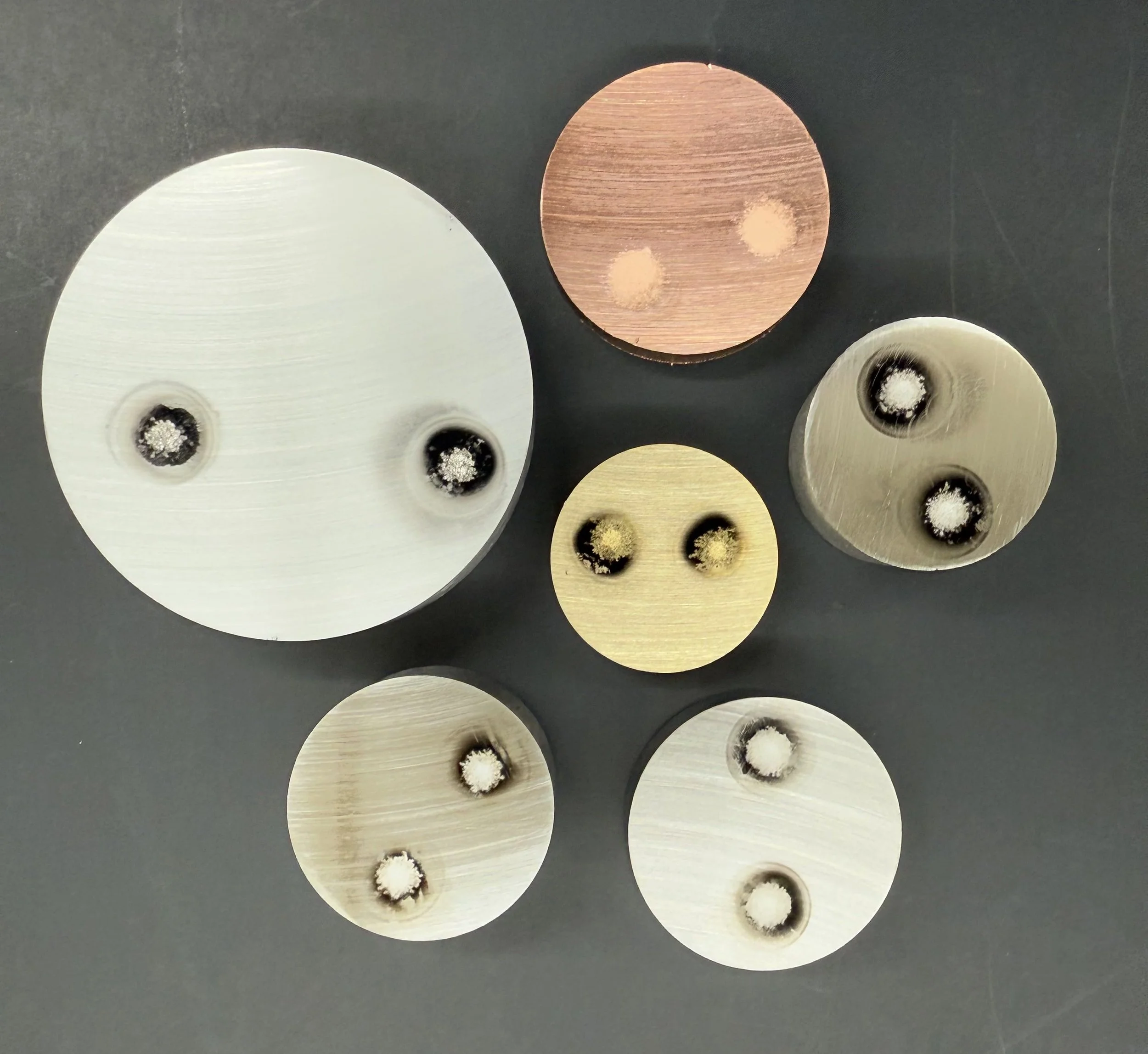
Because OES uses a controlled electrical spark, the test is considered partially destructive. A small burn mark is left on the surface of the specimen at the test location. This mark is typically only a few millimeters in diameter and does not affect the remainder of the sample.
Materials We Analyze
Our laboratory routinely performs OES chemical analysis on:
Carbon Steel
Low Alloy Steel
Stainless Steel
Tool Steel
Aluminum Alloys
Copper Alloys
Nickel Alloys
Cobalt Alloys
Titanium Alloys
Cast Iron
If you're unsure whether your material can be analyzed by OES, our team can review your application and recommend the appropriate testing method.
Materials We Analyze
Depending on the material being tested, OES can determine concentrations of numerous alloying elements, including:
Carbon
Sulfur
Phosphorus
Silicon
Manganese
Chromium
Nickel
Molybdenum
Copper
Vanadium
Titanium
Aluminum
Niobium
Boron
Cobalt
And many additional alloying elements
Applicable Standards
Chemical analysis is performed in accordance with applicable ASTM methods and customer specifications, including:
ASTM E415 – Carbon and Low Alloy Steel
ASTM E1086 – Stainless Steel
ASTM E1251 – Aluminum and Aluminum Alloys
Customer and industry-specific specifications
Test Reports
Each chemical analysis report includes:
Applicable test method
Individual elemental concentrations
Material identification (when applicable)
Comparison to specification limits (when requested)
Complete test documentation
Contact us to discuss your testing requirements. Our team can review your specifications, confirm the appropriate test method and material needed to perform testing, and provide a prompt quotation.